
Roche CSO Marco Skolik About Active Crisis and Emergency Management
Roche in Penzberg is one of Europe’s leading biotechnology sites. For many years, operations there have been conducted in accordance with high standards of safety and resilience. The site relies on close coordination with the police, fire department, and emergency medical services, regular large-scale drills, and clearly defined points of contact. The goal is a robust hazard prevention system that consistently integrates internal structures with external authorities, thereby strengthening the security of supply for patients worldwide.
GIT SECURITY International (German edition GIT SICHERHEIT) spoke with Marco Skolik, Head of Corporate Security, and Jörg Kastner, Head of Crisis and Emergency Management at the Penzberg site.


Mr. Skolik, Mr. Kastner, the German Bundestag recently passed the Kritis umbrella law. Since it involves the implementation of an EU directive, it has long been clear that it would be enacted. Does Roche already comply with all the requirements set forth in the law?
Marco Skolik: Of course, Roche has been working intensively on implementing the underlying EU directive for quite some time. However, the subject matter is very complex overall. On the one hand, it involves requirements for critical infrastructure; on the other hand, as a facility, we are also classified as a “major accident facility.”
Jörg Kastner: At this point, it has not yet been definitively determined whether the Penzberg site actually falls under the new provisions of the Critical Infrastructure Framework Act. The relevant thresholds will be established at a later date via a statutory order. Should the law apply to us, we will, of course, comply with the corresponding requirements. However, we expect that the main implications for us will primarily involve additional documentation and reporting requirements. In all other areas, we are already very well positioned. Crisis and emergency management are not just on paper at our company—they are actively put into practice.
As a biotechnology company, it is in our very best interest to make our processes as resilient as possible so that we can reliably care for patients worldwide at all times—in keeping with our corporate purpose: “Doing now what patients need next.”
As part of a reorganization of Germany’s security architecture, the law is primarily aimed at operators of critical infrastructure—though it also places greater responsibility on authorities and organizations with security tasks (BOS). In your view, what is the current state of collaboration between BOS and companies?
Marco Skolik: In my view, there is already good contact in many areas. At the same time, there is still potential to further strengthen cooperation and improve processes. While there are many facilities—including our site in Penzberg—that have built very close and trusting relationships with the relevant authorities and organizations over the years, However, this collaboration is by no means universal, even though it is absolutely critical to effective hazard prevention and crisis management.
I therefore strongly hope that the authorities themselves will also shift their mindset and proactively reach out to critical infrastructure companies as well as facilities at risk of major incidents. In my view, a significantly greater focus on public-private partnerships would be crucial here. After all, effective emergency response is not only demonstrated in an actual emergency but already in the preparation for it. Even major crises, such as those occurring with increasing frequency, can be better managed when authorities and companies work hand in hand. Existing resources must be used effectively. This also applies to our population when it comes to self-reliance.
Jörg Kastner: In my view, it is also important that critical infrastructure facilities be taken into account when preparing for incidents, even if these do not fit the classic or typical operational scenario. Companies bring their own potential, specific hazard situations, and unique conditions to the table, all of which must be incorporated into planning.
This applies in particular to overarching response plans for emergency scenarios, such as the response plan for life-threatening situations in Bavaria. While this plan outlines measures for all public emergency response units, it has so far failed to take into account—or has done so only inadequately—internal corporate structures such as plant fire departments, plant rescue services, or security facilities like plant security, as well as the specific conditions within the industrial sector. In our view, there is still work to be done in this area.
Let’s break this down a bit using the Roche sites for which you are responsible. First, to put things in context: Roche in Penzberg is practically a city in its own right—and at the same time a significant part of Penzberg?
Marco Skolik: Roche in Penzberg is one of the largest biotechnology centers in Europe and an innovative center of excellence for life sciences in the greater Munich area. With 7,900 employees, the site is the largest employer in the Bavarian Oberland and one of the region’s most important economic drivers. The facility, which spans 590,000 square meters, is a globally significant hub for the research, development, and production of biopharmaceutical active ingredients, diagnostic tests and reagents, analytical systems, as well as molecular tumor profiling and gene therapy. From Penzberg, we are thus contributing to better healthcare for patients worldwide.
You’re probably quite familiar with the police, fire department, emergency medical services, etc., both personally and in terms of their organizational structure, aren’t you?
Marco Skolik: Yes, that’s certainly true. We have a particularly good and regular exchange with the police, the surrounding fire departments, and the emergency medical services. Response scenarios are planned jointly in advance and also tested in practice.
In addition, there are already coordinated processes in place for certain aspects of day-to-day operations. This includes, for example, close cooperation between our plant security and the police—such as when filing a police report, which in many cases can be done directly with plant security without having to visit the relevant police station in person. Cooperation between our plant fire department and the Penzberg Volunteer Fire Department during operations in and around the plant is also firmly established.
Particularly noteworthy is the effective and trusting cooperation with the Penzberg Police Station and the Upper Bavaria South Police Headquarters. Over the years, a partnership has developed here that is by no means a given in this form.
Jörg Kastner: In addition, we also maintain a very good and regular exchange with the lower-level civil protection authority at the Weilheim-Schongau District Office. All issues concerning Roche are discussed here openly, constructively, and in a spirit of partnership.
Now, as is often done in large companies, you organize joint drills. Who actually takes the initiative in this?
Jörg Kastner: Fundamentally, we see it as our responsibility to proactively coordinate the scenarios relevant to our site with external emergency responders and to conduct regular drills. As a company, our operations classify us as a so-called “major-accident facility.” This imposes a clear obligation on us to comply with the requirements of the Major Accidents Ordinance and to protect both the public and the environment from harm to the best of our ability at all times.
Marco Skolik: This applies equally to our employees and our physical assets. We have a strong duty of care and set high standards for the safety of our colleagues. In addition, we are required by the government of Upper Bavaria to conduct regular drills in collaboration with external emergency response teams. Against this backdrop, we made a conscious decision last year to hold a large-scale drill annually at our Penzberg site going forward. These drills are conducted alternately with internal personnel and in collaboration with external units.
Furthermore, we see ourselves not only as participants in these drills but also as active partners in emergency response. Whether through our plant fire department, the plant rescue service, or with support from plant security—for example, using drone technology—we are always available to assist with public or external emergency operations. Accordingly, we are also open to requests from external organizations to conduct exercises on our plant premises.
What exactly do you define as the objective here?
Marco Skolik: The central objective is for the participating parties to get to know each other better and to seamlessly coordinate internal and external response procedures. The interfaces with the various authorities and organizations are highly complex in and of themselves. In the event of an emergency, however, these processes must mesh seamlessly—like a precisely calibrated clockwork mechanism. This is exactly where the joint exercises lay the necessary groundwork: they ensure clarity in roles, reliability in procedures, and trust in collaboration—even before things get serious.
Jörg Kastner: The objective goes well beyond the actual day of the exercise. Even the preparation for such a large-scale exercise provides significant added value for everyone involved. Within this framework, the various stakeholders engage in dialogue with one another at an early stage; existing emergency and response plans are reviewed together and assessed to ensure they are appropriately coordinated.
In the run-up to our last exercise, for example, we provided targeted training for our internal teams—namely, the plant fire department, plant emergency medical services, and the emergency and crisis management team—in collaboration with external partners to simulate police response scenarios.
We deliberately opened these training sessions to public emergency response personnel as well. This significantly strengthened mutual understanding of each other’s roles, procedures, and decision-making processes.
The actual exercise then serves as a kind of “reality check” for the jointly developed concepts. It clearly reveals where further coordination is needed and what is already working well. The insights gained are subsequently evaluated systematically and consistently incorporated into the further development of our plans. The goal is to continuously improve cooperation in the event of an emergency and to be even more resilient overall.
Who are the participants, and what is the general flow of the exercise?
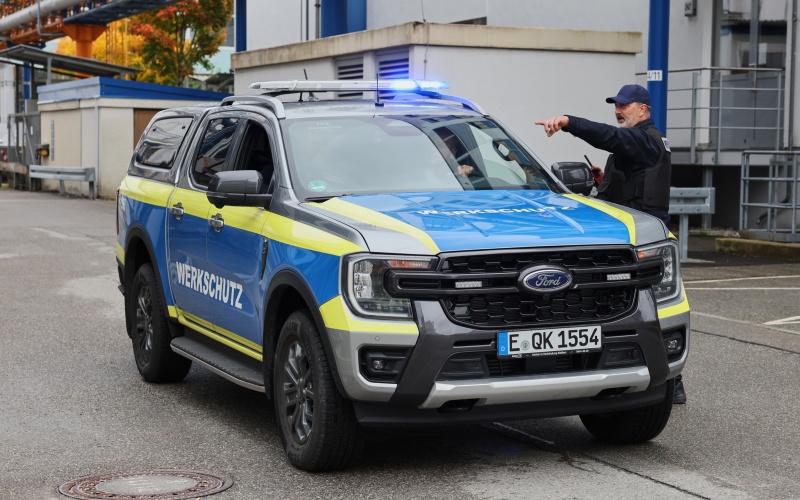
Marco Skolik: As a general rule, we always involve the surrounding fire departments, emergency medical services, and the police in all our large-scale exercises with external forces. Depending on the specific scenario, however, we set different priorities, which are accordingly reflected in the deployment of resources. In the last large-scale exercise, we placed the main focus on plant security and the police for the first time. The background was a police emergency situation—in a sense, the ultimate test among hazardous scenarios. It is precisely here that the coordination between all participating units is particularly complex. Non-police emergency responders may only begin operations after receiving authorization from the police and are subject to the command of a local incident command team from the lower-level civil protection authority. This specific organizational structure (BAO) presents numerous pitfalls, which is why realistic exercises in this context are absolutely critical to success.
This is another reason why we specifically involved external institutions—such as the Bavarian Center for Special Emergency Situations, InPASS (Institute for Patient Safety), and the Bavarian Association for Safety in Business—as well as external staff consultants in the preparation, observation, and debriefing of the exercise.
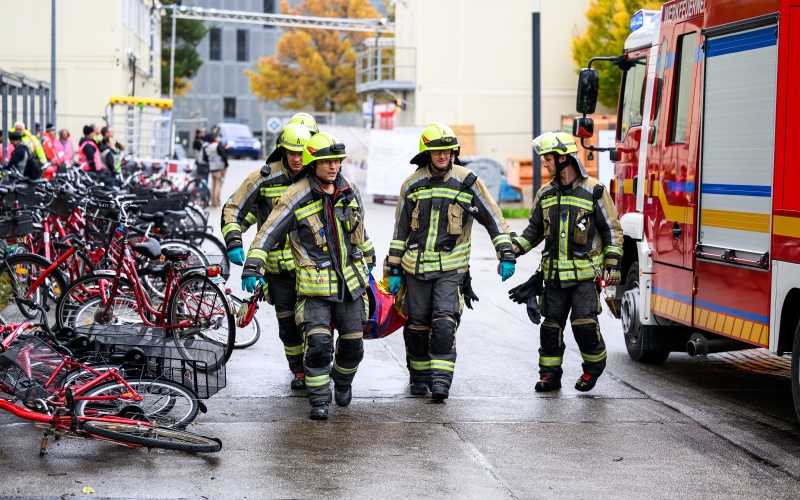
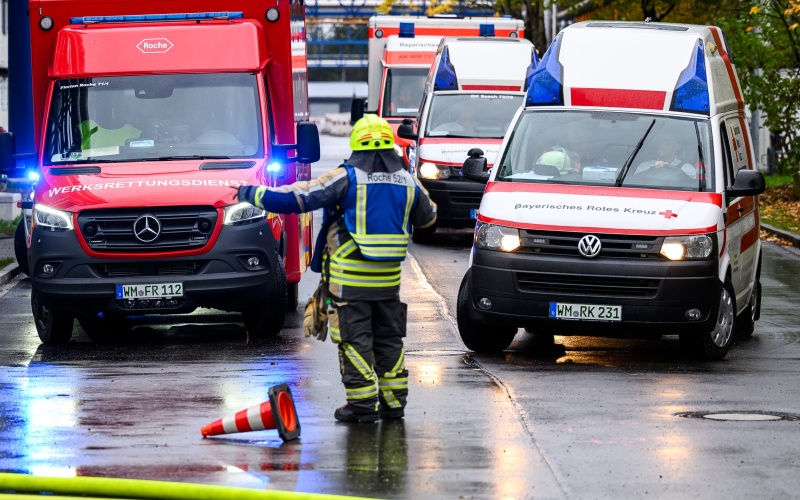
The exercise scenario covered the entire chain of response: from the initial emergency call through police response with support from plant security—particularly through local knowledge, drone technology, and the guidance of those affected—all the way to the triage and care of “injured” individuals by emergency medical services, as well as the suppression of several artificially created fires by the plant fire department. The exercise was designed to be correspondingly challenging and comprehensive.
Jörg Kastner: The foundation for a successful operation is often laid in the very first phase. That’s why we tried to make the scenario as realistic as possible. It began with what was initially a more or less routine plant security operation, although the very first situation report was already a critical point.” The plant security operations center then informed internal personnel of the threat situation and simultaneously relayed the report to the police operations center and the integrated control center.
After the police had resolved the situation, internal and external emergency responders worked together to treat and transport the simulated patients and extinguish the artificially created fires. An important aspect that we practiced in this format for the first time was the care of uninjured individuals by the support service and crisis intervention team. At the command level, it was not only important to coordinate the operational response teams but also to ensure cooperation between the official command structure and our internal emergency and crisis management team.
Did the use of drones play a special role...?
Marco Skolik: Yes, the use of the drone was absolutely critical to success in this scenario. Just about six minutes after the operation began, it was already in the air and providing a live overview of the entire situation. This real-time information enabled the rapid containment of the danger zone and the targeted deployment of police forces. As a result, decisions could be made much more quickly and with greater confidence, which contributed significantly to the swift and successful resolution of the incident.
What did both sides take away from this exercise—and what conclusions do you draw for your own security strategy?
Marco Skolik: Above all,both sides took away one key lesson: Safety comes from practice, trust, and clear points of coordination. The exercise showed where procedures are already working very well and where we still need to fine-tune them together. For our security strategy, this means that we will consistently continue on the path we have chosen—with regular exercises, close coordination, and a clear focus on practical preparation rather than purely formal concepts.
Jörg Kastner: In addition to some important insights into specific details, the topic of psychosocial emergency care was a key finding of the exercise. Several thousand people are on our plant premises every day, and they could be affected in various ways in the event of a major incident. Against this backdrop, we subsequently replanned and further developed this area in collaboration with our internal resources as well as with the district’s Psychosocial Emergency Care Working Group.
The situation posed a challenge not only for the operational response teams but also for our emergency and crisis management team. Many colleagues were confronted with such a scenario for the first time. Due to the initially unclear situation, it was not possible for the team to convene immediately on-site. During this phase, however, we were able to rely on the existing structures and tools for virtual collaboration within the crisis management team.
In the process, specific questions also came to light, such as how an open team workspace can be organizationally isolated in a sensible way in such a situation. These insights are now being directly incorporated into the further development of our security and crisis response plans.
But do you also have ideas regarding the requirements for government agencies when it comes to collaboration in special operational situations? In particular, do you emphasize not only the connection between security and safety, but also the interaction between internal and external forces as an integral part of defining the all-hazards approach?
Marco Skolik: Yes, those are our expectations. From our perspective, authorities must consistently consider security and safety aspects together and view internal corporate structures as an integral part of the all-hazards approach. In the event of an incident, plant fire departments, plant security, and plant emergency response services are not peripheral players but an integral part of hazard mitigation. Early involvement, clear responsibilities, and active cooperation on an equal footing are crucial for this.
Jörg Kastner: From our perspective, it is important that corporate hazard prevention be recognized as an equal partner at all levels. Especially in special operational situations, effective crisis and emergency management can only function if internal and external stakeholders collaborate early on and in a structured manner.
In light of the challenges ahead, a shared understanding is necessary: emergency and crisis management is not a “side job,” but must be conducted professionally, continuously, and with clear responsibilities. The all-hazards approach thrives precisely on this interplay—between security and safety, as well as on the close integration of corporate structures with government response and command organizations.
Mr. Skolik, Mr. Kastner, we touched on this at the outset: These normative realignments do not take place in a vacuum, but against the backdrop of geopolitical changes. Germany, in particular, is—purely geographically—a logistical hub for military movements, as well as for refugees, if necessary, etc. The “Operations Plan Germany,” for example, is viewed not only as a military and governmental task but also as a responsibility for society as a whole. Could you outline how your company is involved in this?
Marco Skolik: We are not yet actively involved. At the same time, as a company, we have a strong vested interest in being prepared for every conceivable scenario—especially in light of current geopolitical developments. Accordingly, we are continuously analyzing the situation and reviewing and refining our internal processes. We are currently developing an overarching strategy to actively engage with stakeholders such as the Bundeswehr in the future. The goal is to systematically advance integration with the “Operations Plan Germany” and to create a functional, resilient interface between corporate preparedness and societal resilience.
Jörg Kastner: As my colleague Marco Skolik already mentioned, the information available to us on this matter is still rather limited at this point. Regardless, our core mission as a healthcare company is clearly defined: We supply patients worldwide with life-saving medications and diagnostics. It is in our very best interest to be able to fulfill this mission even under difficult conditions. In this way, we as a company are already making a significant contribution to the resilience of our society. Our system of emergency, crisis, and business continuity management is specifically designed to ensure we remain capable of acting even in such scenarios and to restore stable operations as quickly as possible should disruptions occur.
most read
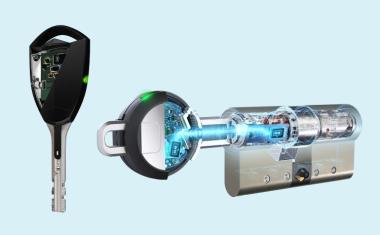
Digital Access with the Familiarity of a Key: A Versatile Combination
As organizations upscale, downsize, or onboard new locations, facility managers must more flexibly manage access control ever and frequently adapt to new situations.
Programmable keys and digital locking cylinders can simplify access and compliance
The key to meeting building managers’ growing security and compliance challenges – without increasing workload or costs – is the implementation of smarter access
TEST | Perimeter Security: Optex's EchoPoint Impresses in Real-World Testing
GIT TEST SERIES – PART 3 | EchoPoint excels in field testing with precise fibre-optic detection and intelligent event classification
How Dom Eniq Transformed Access Control at Amsterdam’s Muziekgebouw Concert Hall
Muziekgebouw Amsterdam upgraded to the DOM Eniq electronic locking system, giving staff full control over access rights
AI Reality Check: Genetec CEO Pierre Racz
AI in security: Genetec CEO Pierre Racz cuts through the hype and outlines what really works in practice.