Four Key Industry Figures Discuss Native Integration of Wireless Access Technology
A seamless building benefits everyone, users and facility managers alike. Workflows can become more efficient, and every stakeholder enjoys greater peace of mind with streamlined interactions that start at the front entrance and continue throughout the site.
Most organizations already recognize the importance of connecting access with security systems like alarms and CCTV, as well as HVAC and a growing range of business software packages. To connect systems even further, security managers need complete, convenient, digital control over as many building openings as possible – not just doors – rather than run digital and mechanical access management in parallel.
The most effective and cost-efficient way to extend their reach and oversight is with digital locks integrated into their system. In this round table Q&A, Walter Sackl, Partnership Manager DAS at Assa Abloy Opening Solutions EMEIA, discusses some of the foremost issues around the integration of the latest digital access technology like Aperio wireless locks with representatives from Nedap, Honeywell, and Motorola.
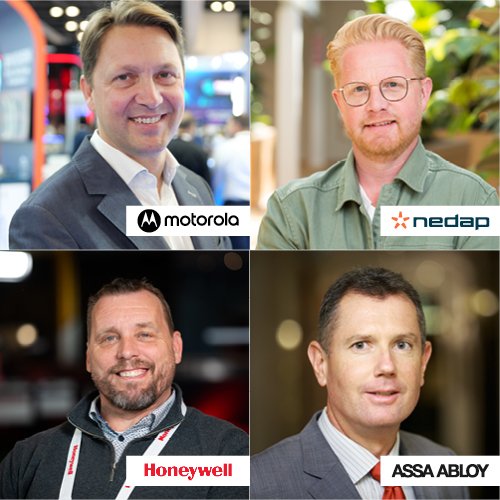
Walter Sackl: How do you rate the importance of wireless lock integration, both for you as an OEM and for your customers?
Jeroen van Os, Commercial Integration Manager at Nedap: It is always important to see things from the customer perspective: what is the benefit for them? We have integrated Aperio in two ways, both wirelessly online and using the OSS offline version. Nedap was one of the first adopters of the OSS standard several years ago because we believe in open standards. This gives customers the opportunity to have mixed use of both formats. The Aperio E100 Escutcheon is the most popular door device in Assa Abloy’s offering.
Frédéric Haegeman, Director Access Control International at Motorola: Wireless locks are ever more frequently inquired about by our system integrators and end-users. They give huge flexibility to the customer from a scalability and modularity point of view, allowing them to mix and match. Online integration provides real-time security, and the Assa Abloy Aperio portfolio of locks in combination with our software allows the end-user to achieve that.
Servaas Kamerling, Offering Lead at Honeywell Security and Access Solutions Europe: The security industry is so expansive that multiple systems are often required. What is most important for customers using many diverse platforms is that no matter where a notification comes from – an alarm, a tamper detector, or another device – each one arrives and can be managed by the security operator in the same manner. With this integration, they do not have to learn ten different systems to help drive building efficiency with all systems working together.
In which sectors is there especially strong demand for wireless lock integration?
FH, Motorola: Where we see high attraction is in education, commercial real estate, and local government.
SK, Honeywell: We have seen wireless locks have the greatest success in applications like educational campus buildings, particularly student accommodation, and office spaces where interior doors can be seamlessly integrated into our LenelS2 access control platform. In hybrid access control systems, readers are often used at the perimeter or department entries, and locks are used deeper in the facilities for individual offices. Wireless installations are typically more cost effective when simply replacing mechanical locks with electronic locks.
JvO, Nedap: Education and healthcare, especially in Belgium – plus aviation at Schiphol Airport. It is very beneficial in these environments that customers do not have to run cables to so many rooms, which saves costs. With Wireless Online they can also open doors remotely. It is one example of a great fit between Nedap and Assa Abloy products.
Looking forward, how important do you consider mobile access to be?
SK, Honeywell: Customers are always looking for the most convenient solution and it is hard to argue against the convenience of a plastic access card so it is unlikely that these will disappear completely. However, plastic is not the most environmentally friendly option and can be forgotten or misplaced. People rarely forget their mobile phone. In the end, it is the customer’s choice. The adoption of mobile credentials will grow quickly, but I think there will be a range of options to choose from for a long time to come, including biometrics.
FH, Motorola: Mobile access comes with a conflict: what is the customer’s willingness to pay for it? People really want it, but this issue remains. It is an indisputable technology trend that cannot be ignored for the simple reason that younger generations see the mobile phone as an extension of their arm. They want to do everything on the handset. For them, the digital wallet is more important than a physical wallet. This technology needs to be part of the default offering, but that will take some time. However, even regions where adoption has so far lagged will quickly catch up.
JvO, Nedap: We really see a breakthrough, especially now ‘big tech’ enterprises like Apple and Google are focusing on mobile access, which pushes the market towards mobile. It is a major focus of the Nedap access portfolio with better integrations in the mobile space. Wallet badge is a big priority for us. Our solutions, such as AEOS, are mostly used in complex companies, with many sites, many users, and different types of users: critical infrastructure, the finance sector, and in Poland especially the fast-growing real estate sector.
Coming in more detail to the integration of Assa Abloy’s Aperio wireless locking technology: this was developed by design to integrate natively into large OEM systems, rather than be just an ‘add-on’. How does Aperio integration compare to other products? Are there important differentiators?
JvO, Nedap: We hear good feedback from our channels. They see the differences in the integration between Aperio and some other manufacturers when it is implemented in their projects. The documentation is very clear; customers do not want any hassle when they are integrating, They want to get on with their project. Something to highlight is the broad range of Aperio devices, from escutcheons to handles, cylinders, and locks.
FH, Motorola: This is a leading technology for the smart building environment. Aperio offers the flexibility to integrate, with security, quality and aesthetics. This wireless lock enables customers to implement real-time security; it allows them to scale up, going into the hundreds of doors rather than just tens. For me, Aperio is an extension of a total access solution, an edge device. The question is – from a strategic, long-term view – how smart can you make your edge device to give even more benefit to the building user?
What are the most important challenges for security management in the coming years?
SK, Honeywell: Building managers want to ensure that everyone who visits has the best experience possible. Safe, secure, efficient buildings should make it easy to book spaces and visit people. Accessing and using a building ought to provide a frictionless experience, open and welcoming but at the same time providing the security and safety that people expect. This balance is going to be more important than it was in the past. These are interesting times for our industry.
FH, Motorola: Whoever has the right answer will probably win the million-dollar prize! The future lies where smart building infrastructure makes a seamless bridge to user experience – from a technology point of view, the user’s interaction with a building in terms of storing goods in a locker, parking a vehicle, inviting visitors, booking meetings, visiting the food court and so on. These kinds of interaction today require multiple technologies or systems, all driven from the mobile, which is where the answer lies for a truly smart building.
JvO, Nedap: Friction is the most important challenge for the user. We are all accustomed to the most intuitive interface, on our phone. So, if a user trying to open a door has to think about the fact that two platforms are interacting, they do not accept that any more. We need to focus on what those in the field actually experience, not just the technical side. This is an issue for the whole security market: we are very technically focused and can all lean more on user experience. We need frictionless access. In addition, cyber threats are becoming more important: an integration must not be the point of failure, it must be cyber secure because it becomes part of our platform.
SK, Honeywell: Cyber security is extremely important. You only need to glance at the news to realize how critical it is that we ensure protection of data, protection of networks, protection of a system’s integrity. Standards are really important, from the EU and beyond, including ISO 27000, NIS2 and CRA. It is difficult for customers to stay abreast of rapid developments in regulatory compliance and requirements, and up to us as manufacturers to provide help and support where required.
WS, Assa Abloy: In meeting the many security challenges of the future, we continue to champion the benefits of native integration. Native integration between digital devices and an access solution ensures that security teams have more control and extend their reach, without adding to an already busy workload. It does this by fully integrating new locks with the single system database. Administrators update one interface, one database, once: there is no more running systems in parallel or duplicating tasks. This is one of the advantages of Aperio wireless locks. Also, when an OEM integrates Aperio with their system, all future Aperio products are already integrated. These are just two reasons why Aperio continues to win so many industry awards, from Intersec, Detektor, and this year being named BW’s Most Innovative Security Product of the Year. With Assa Abloy’s broad experience in digital access, and specifically its integration expertise, our OEM partners can help their customers digitize with confidence.