False Alarms: When the Cost Exceeds the Fire
For facilities managers and system integrators across Europe, false alarms are not an abstract inconvenience. They carry a direct cost: halted production lines, evacuated staff, emergency service callouts and the potential loss of in-process product. Every time a facility stops for a false alarm, the financial impact registers before anyone has reached the fire exit.
Klaus Friebe, Regional Sales Manager, Northern Europe, Hochiki Europe

This is a conversation I have regularly with customers," says Klaus Friebe, Regional Sales Manager for Northern Europe at Hochiki Europe. "The technical challenge of protecting demanding industrial environments is well understood. What receives less attention is the operational cost when the wrong product is specified. Correct specification is not just a compliance question. It is a business continuity question."
That distinction was central to a recent installation at Kervo, a specialist fruit processing business in Neer, Netherlands, which has cultivated and processed Morello cherries since 1980 and now supplies bakeries and fresh food retailers across Europe and the UK. When Kervo moved into a new manufacturing facility, installer JTI Brandbeveiliging faced an immediate challenge: the steam generated during food production and cleaning created conditions that standard detection devices handle poorly.

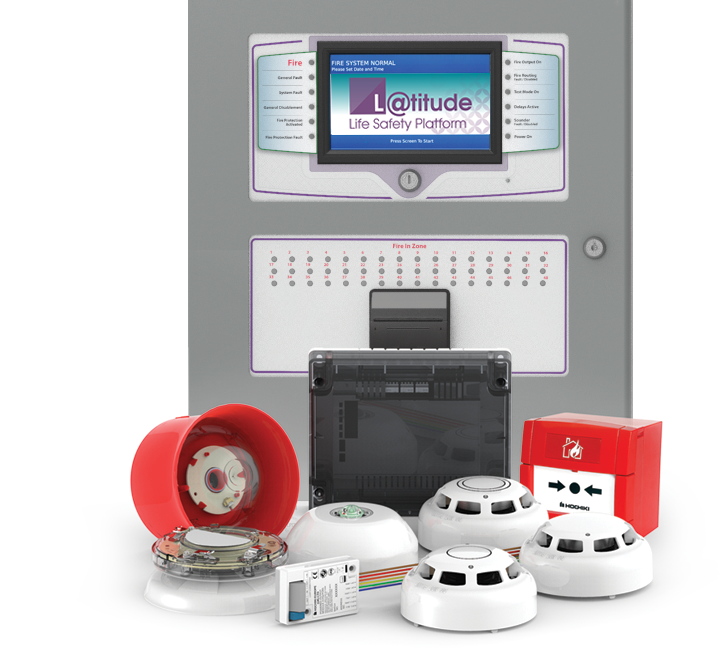
"We needed devices that could manage the false alarm risk without compromising detection performance," says Luciën van Eldijk, lead engineer at JTI Brandbeveiliging. "Hochiki's weatherproof call points, sounders and sensors provided exactly that. Combined with the Latitude fire control panel, they gave the customer a system that works reliably in a genuinely demanding environment."
The Kervo facility reaches over 40 metres in height and required more than 2.5km of cabling. Hochiki's weatherproof ESP addressable devices were deployed throughout, supported by the Latitude panel, which carries EN 54 certification: the applicable compliance standard for fire detection systems in the Netherlands. The Latitude panel also holds BOSEC certification, a mandatory requirement for fire detection systems in Belgium. The system supports up to 5,000 event log entries with 20,000 inputs and outputs across the network, providing both the scale Kervo required and capacity for future expansion as the business grows.
For industrial and food processing operators across Northern Europe, the Kervo project demonstrates that false alarm management is a specification decision, not an operational inevitability. Hochiki's ESP range and Latitude platform are EN 54 certified, meeting the compliance requirements applicable in the Netherlands and across the wider European market. For specifiers and installers working in Belgium, the Latitude panel's BOSEC certification provides the additional assurance that the Belgian market demands.
To learn more about these products visit the Hochiki website or speak to your local team.