Smart Fire Alarm Technology: How Siemens Connects IoT Detectors to the Cloud
Digital solutions have long since found their way into fire detection technology. One principle, however, has remained largely unchanged for decades: the systems are triggered only when necessary. Siemens is now countering this with a new approach using IoT-connected devices: Based on the cloud, these devices not only utilize new detection and self-monitoring technologies, but also perform key tasks in autonomous buildings.

Conventional fire alarm systems are primarily event-driven. This means that, while they respond to defined thresholds as early as possible, they naturally do not detect them until the fire has reached an advanced stage. With a new development, Siemens is now fundamentally changing this approach: The new Sinteso Nova fire detectors continuously collect, analyze, and interpret data.
As a result, such continuous, data-driven systems enable a new level of fire safety. Furthermore, they pave the way for future-ready buildings that increasingly monitor and organize themselves. This is because so-called autonomous buildings not only react to events but also actively assess conditions and optimize them. Fire protection thus becomes an integral part of intelligent, self-learning building operations.
content:
- Fast and Accurate Fire Detection Through Intelligent Sensing Technology
- Continuous alarm capability through smoke ingress monitoring (SES)
- IoT Connectivity as the Foundation for Autonomous, Sustainable Buildings
- Versatility, Sustainability, and Scalability
- A Vision for Smarter, Safer, and More Efficient Buildings
- Carsten Meißner, Senior Consultant, Safety Lifecycle Portfolio, Siemens Smart Infrastructure, Germany
Fast and Accurate Fire Detection Through Intelligent Sensing Technology
A key feature of Sinteso Nova is its ability to detect fires very quickly while ensuring the highest level of false alarm immunity. This is made possible by ASAplus (Advanced Signal Analysis) technology, which combines optical multi-wavelength sensors with dual thermal detection.
For this new generation of fire detectors, Siemens has now taken this proven technology to a new technical level: Up to ten sensors in the fire detector continuously analyze different signal sources and correlate them with one another. This not only detects the presence of smoke but also determines whether a fire is actually occurring.
This sophisticated analysis results in a significantly improved response time while simultaneously reducing false alarms. The Sinteso Nova fire detectors make a significant contribution to enhancing operational safety. This helps prevent unnecessary evacuations and operational disruptions.
Especially in critical areas such as hospitals or data centers, this combination of speed and precision is crucial, as any delay or misinterpretation can have serious consequences. Siemens is so confident in the performance of this technology that the company offers a reimbursement guarantee covering the costs of a fire department response—up to 2,000 euros—in the event of a false alarm.
Continuous alarm capability through smoke ingress monitoring (SES)
Another outstanding feature of the new generation of fire detectors is the integrated Smoke Entry Supervision (SES). This technology continuously monitors the detectors’ smoke entry openings and ensures that smoke can be detected unimpeded at all times. This guarantees constant, real-time detection capability, allowing operators to respond early before critical situations develop.
The particular benefit is most evident during ongoing operation: This continuous monitoring complements the detectors’ intelligent detection algorithms and goes well beyond traditional maintenance approaches, as it is not limited to inspections but remains active at all times.
This addresses an often-underestimated risk: the gradual degradation of detectors due to contamination or mechanical influences. In high-traffic or demanding environments, SES ensures that detection quality remains stable over the long term, thereby making a significant contribution to the reliability and availability of the entire system.
IoT Connectivity as the Foundation for Autonomous, Sustainable Buildings
Sinteso Nova is designed from the ground up as an IoT-enabled system and can be seamlessly integrated into cloud-based platforms. This connectivity enables a wide range of new features that go beyond traditional fire detection. Key features include real-time monitoring of all system statuses, remote diagnostics and digital service access, predictive maintenance based on condition data and digital reports, and integration with the open Building X platform and other future digital applications.
As part of the Siemens Xcelerator portfolio, the new detectors are compatible with cloud-based applications such as the Building X Fire Connect apps. In addition, the temperature data collected by the detectors can be transmitted and utilized: The Building X Environmental and Air Quality Application FIRE enables the realization of additional potential for increasing a building’s energy efficiency and sustainability.
This is made possible by the extensive information the detectors collect via their ten sensors. As a result, a fire detector now provides more sensor data than ever before. The resulting depth of data creates a unique foundation for detecting safety-related events early on while simultaneously providing a comprehensive understanding of a building’s condition.
In addition to traditional fire safety information, the continuous data stream also provides insights into temperature trends, air composition, and other environmental parameters. Through the intelligent analysis of this data, changes in environmental conditions and potential anomalies can be detected early on. This provides transparency regarding operational conditions and helps to specifically identify opportunities for optimization in fire protection, building operations, indoor climate, and energy efficiency.
As a result, fire safety is evolving into an active component of building intelligence and supports the vision of fully autonomous buildings: a system that optimizes itself, detects errors early on, initiates corrective actions, and requires human intervention only when it is truly necessary. Artificial intelligence is not an end in itself, but rather a tool for operating buildings more economically, comfortably, and resiliently.
Versatility, Sustainability, and Scalability
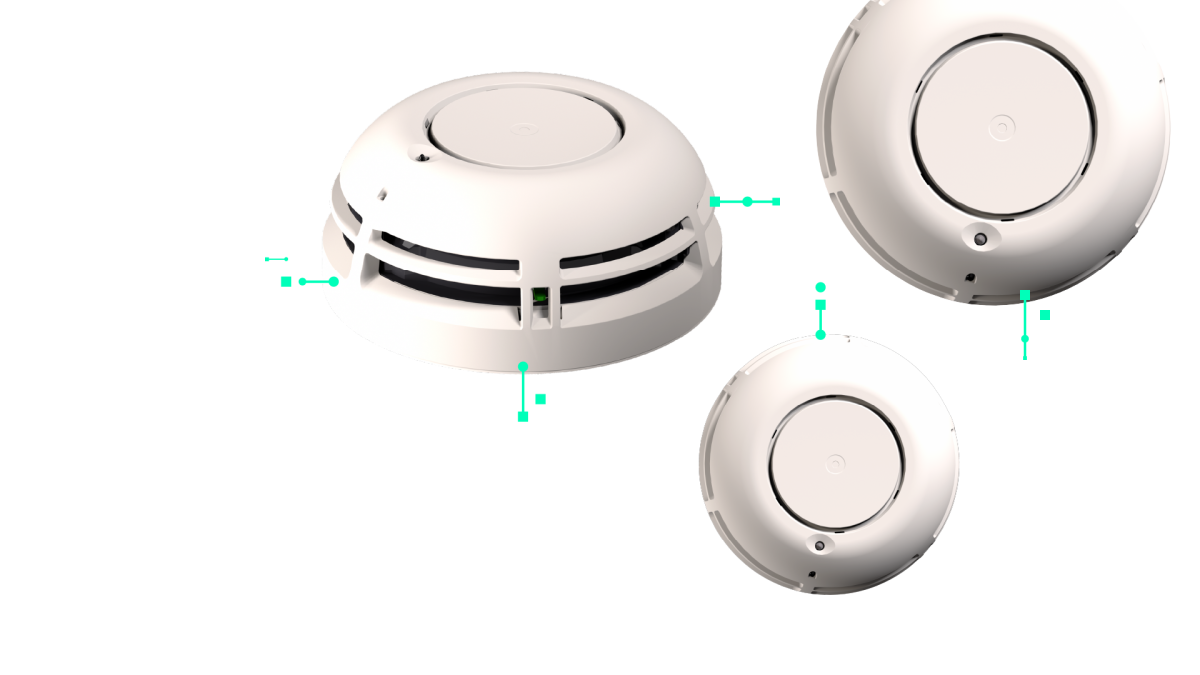
Sinteso Nova fire detectors are designed to be used in a wide variety of applications, such as hospitals, data centers, universities, hotels, and industrial and logistics facilities. What all these environments have in common is that they place high demands on availability, safety, and efficiency.
Data centers, for example, face unique fire safety challenges due to their high energy density and the need for uninterrupted operation. Risks such as overheating and electrical malfunctions must be detected early.
The Sinteso Nova fire detectors not only help operators improve the availability of critical IT and electrical infrastructure but also provide deeper insights into the condition of the systems. Cloud-based monitoring and predictive maintenance enable quick and proactive responses. This minimizes disruptions while efficiently protecting sensitive equipment.
In other industries, there are often multiple, geographically dispersed buildings with different areas of use. Here, centralized and reliable fire safety management is essential to ensure safety standards without disrupting day-to-day operations or the guest experience. The scalability of these systems makes it possible to centrally monitor and control both individual buildings and complex, distributed properties.
The ability to modernize existing systems in phases also ensures that investments are protected and that systems can be brought up to date without completely replacing the infrastructure. Existing fire alarm control panels remain compatible, so it is not necessary to replace the entire system. Thanks to plug-and-play integration, including the automatic import of existing configurations, installation effort and risks can be significantly reduced.
The system’s sustainability is confirmed by the Siemens EcoTech Label. This includes energy-efficient electronics, optimized materials, and a resource-efficient design with an improved carbon footprint.

A Vision for Smarter, Safer, and More Efficient Buildings
With Sinteso Nova, Siemens is consistently building on its own tradition in fire protection and further developing it toward digital, intelligent systems. The combination of fast and precise detection, continuous self-monitoring via SES, and comprehensive IoT connectivity creates a new level of safety.
At the same time, the integration of cybersecurity lays the foundation for reliable operation in highly networked environments. Fire protection thus becomes a central component of autonomous buildings that can monitor and optimize themselves. Consequently, Sinteso Nova represents not only a new generation of products but also a fundamental paradigm shift that turns the vision of smart, safe, and efficient buildings into reality.