EchoPoint EP9300 locates and classifies events along extended fibre-optic sensor routes
How reliably can a security system monitor an extensive perimeter while locating and classifying events along long distances? EchoPoint from Optex uses Distributed Acoustic Sensing (DAS), turning optical fibre into a continuous sensing element. GIT has already examined how the technology performs in practice: published in GIT SECURITY International 3/2026 and GIT SICHERHEIT 9/2026, the field tests conducted together with independent security technology expert Markus Piendl saw EchoPoint successfully pass the test scenarios.
For extensive facilities, the point of detection may be far away from the control room. At airports, railway infrastructure, distribution centres or critical infrastructure sites, simply reporting an alarm therefore leaves an important question unanswered: where exactly is the event taking place?
EchoPoint uses optical fibre as a continuous sensing element. Mechanical and acoustic impacts along the monitored route alter the light backscattered within the fibre. The system analyses these changes, assigns them to an event location and supports the classification of different types of activity.
This is the principle behind Distributed Acoustic Sensing, or DAS. According to Optex, EchoPoint can pinpoint activity to within ±6 metres. Virtual zoning allows the monitored route to be divided into software-defined detection areas, while the EchoPoint series covers distances of up to 100 kilometres
Classifying what happens along the perimeter
Location represents only one part of the information available. Characteristic vibration patterns allow DAS to examine the nature of activity taking place along the sensing fibre.
EchoPoint uses classification algorithms to distinguish different types of event. In fence applications, the system can differentiate between climbing and cutting. With buried sensing cable, its classification includes footsteps, manual digging, machine digging and vehicle movement.
For security operators, this provides additional context alongside an event position. Alarm information can be passed to other security systems using XML over TCP/IP. The manufacturer‘s documentation also specifies GIS integration and optional I/O modules, while the product information describes integration with VMS, CCTV, PSIM and control-room environments.
This combination becomes particularly relevant on long boundaries. Precise location information can direct subsequent verification towards a defined section of the perimeter instead of presenting operators with an alarm covering a broad geographical zone.
Fence-mounted, buried or hybrid
Perimeters are rarely uniform. Fencing, open areas, access routes and differing ground conditions can all appear within the same site. The fibre-optic sensing principle therefore supports different deployment methods.
The sensing cable can be attached to a fence, installed underground or deployed in a hybrid layout combining both approaches. For buried applications, the EP9300 datasheet specifies an installation depth of between 30 and 90 centimetres, depending on soil conditions.
Applications listed by the manufacturer include airports, distribution centres, critical infrastructure, data conduits and railways. The current Optex product information additionally identifies environments including data centres, utilities, power stations and military facilities.
The sensing fibre itself is passive along the monitored route. During GIT‘s field testing, independent security technology expert Markus Piendl highlighted this property in relation to applications requiring reliability, electromagnetic compatibility and resistance to lightning-related effects.
Resilience along long detection routes
GIT’s practical testing left a positive impression of EchoPoint, and a closer look at the system architecture reveals several convincing technical features. Resilience is one of them, particularly where long detection routes and extensive sites are concerned.
EchoPoint EP9300 supports both single-line and loop configurations. According to the product documentation, the loop configuration provides cut tolerance using both channels. Optional redundant processing allows a second processor to take over in the event of a processor failure.
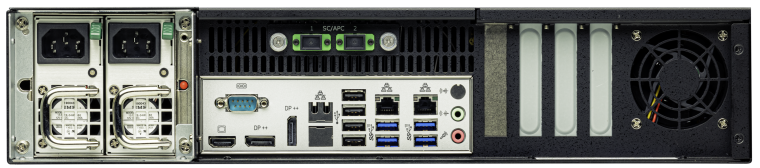
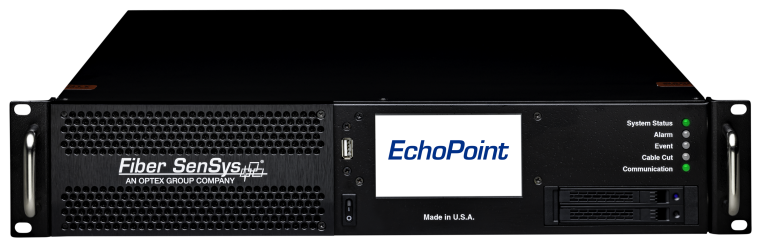
The EP9300 controller is a 2U rackmount unit. Its technical specification lists two redundant, hot-swappable hard drives, 120 watts of power consumption, dimensions of 48 × 51 × 9 centimetres and a weight of 11.4 kilograms. The specified controller operating range is 0 °C to 50 °C at 20 to 80 per cent non-condensing relative humidity.
The datasheet differentiates between maximum sensing distances according to the deployment. It specifies a maximum of 80 kilometres per processor for fence applications and up to 100 kilometres per processor for buried, pipeline and data-cable security applications. The current product page lists overall detection coverage as 100 kilometres per processor and 50 kilometres per channel.
Tested by GIT under real-world conditions
Specifications are one thing; performance under practical conditions is another. EchoPoint has already undergone an extensive GIT field test, published in GIT SECURITY International 3/2026 and GIT SICHERHEIT 9/2026. Together with independent security technology expert Markus Piendl, GIT evaluated the technology at an Optex test site under realistic conditions, covering both fence-mounted and buried detection – see:
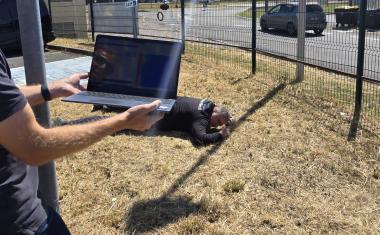
The programme deliberately went beyond straightforward detection. Fence tests included climbing, positioning a ladder against the fence with a blanket serving as a damping layer, and forcing open or cutting through the fence mesh. The buried route was tested with walking, running, crawling and rolling. System testing also covered live sensor data, video verification, alarm handling, integration with Milestone XProtect and comparison of reported event positions with the GPS coordinates of the test points.
The outcome was highly successful. EchoPoint reliably detected every prepared attack scenario on both the fence-mounted and buried sensing routes. Pre-alarms, main alarms and tamper alarms could be monitored in real time and assigned to the corresponding events, while the impact of configuration changes was immediately visible. The published assessment records the fence detection tests, buried detection tests and system integration tests as passed in full.
For perimeter security planners, this practical perspective is an important complement to the datasheet. Maximum range alone does not determine the usefulness of a detection technology. What matters operationally is whether a system can identify an event, establish its position, provide meaningful classification and pass the information into the security infrastructure responsible for verification and response.
The GIT test demonstrated these elements working together under realistic test conditions. That is arguably where the relevance of Distributed Acoustic Sensing becomes clearest: one continuous fibre can provide both a detection route across an extensive perimeter and data that supports the subsequent assessment of an incident.