
Protection alone is no longer enough today. Safety shoes are designed not only to protect employees from hazards, but also to support them during long workdays. Factors such as weight, fit, cushioning, and individual foot shapes are playing an increasingly important role. In this interview, Dr. Katina Ehl, Head of Innovation, Biomechanics & Orthopedics at Elten, explains how lightness, ergonomics, and custom fits influence the comfort of modern safety shoes.
GIT SAFETY: Dr. Ehl, safety shoes must, first and foremost, provide protection. Why is comfort also so important?
Dr. Katina Ehl: Because protection and comfort are inextricably linked. Safety shoes are worn for many hours every day. If they pinch, slip, or don’t fit properly, it affects your well-being. At the same time, safety footwear can only provide optimal protection if it fits properly and, for example, the toe cap is correctly positioned over the toes. That’s why we don’t view comfort as an added benefit, but rather as an essential component of modern safety footwear.
What role does fit play in this, and why do you talk about different foot types in this context?
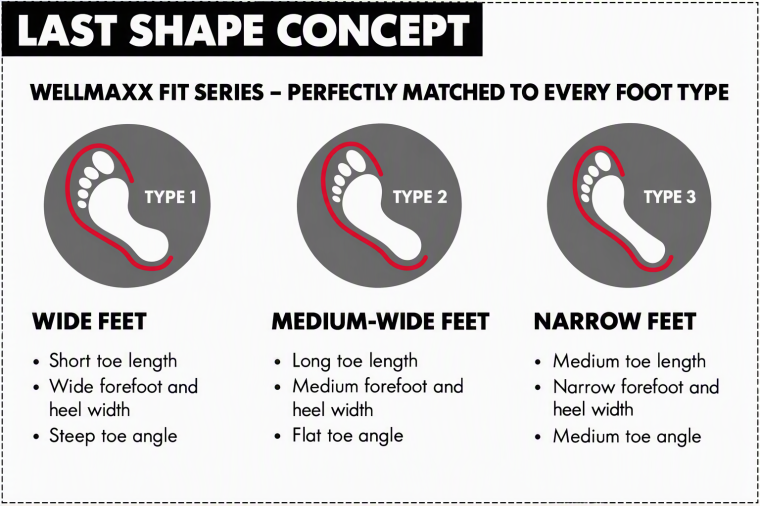
Dr. Katina Ehl: The fit is crucial. Many people believe that the right shoe size automatically means a shoe fits well. In reality, however, feet differ significantly in shape and volume. Two people can wear the same shoe size and still have very different requirements for a safety shoe. Some need more room in the forefoot area, while others benefit from a narrower fit. Standard solutions are inevitably based on the average. That’s why we want to offer as many wearers as possible a fit that matches their foot type.
For many users today, protection alone is no longer enough. What are the current expectations for modern safety shoes?
Dr. Katina Ehl: The protective function remains the top priority. At the same time, users today expect more than just compliance with standards. A modern safety shoe should make everyday work easier. It should fit well, support movement, and remain comfortable even after many hours of wear. Added to this are aspects such as light weight and a modern design. Many safety shoes today are visually more similar to casual or athletic shoes. Because safety shoes are often the piece of personal protective equipment worn the longest each day, users today pay attention not only to protection but increasingly also to design, comfort, and ergonomics.
In biomechanics, the foot is considered a highly dynamic system. What does this mean for the development of modern safety shoes and their subsequent comfort?
Dr. Katina Ehl: This has a major impact. The foot changes its shape multiple times with every step. Width, height, and load distribution are not the same in every phase of the step. That’s why purely static considerations often fall short. We must design safety shoes in such a way that they offer the foot sufficient freedom of movement while simultaneously providing secure support. When a shoe supports the foot’s natural function, it creates a harmonious wearing experience. The foot has the necessary space and, at the same time, the required support.
In addition to fit and freedom of movement, the weight of a safety shoe also plays an important role. Why?
Dr. Katina Ehl: Because safety shoes are worn for many hours a day. Every additional gram is moved thousands of times during a shift. That’s why weight can have a noticeable impact on comfort. Many users find lightweight safety shoes less burdensome, and they can help reduce fatigue throughout the day.
Elten has developed Tavixx, a line of particularly lightweight safety shoes. What’s the idea behind this, and what role does lightness play in comfort?
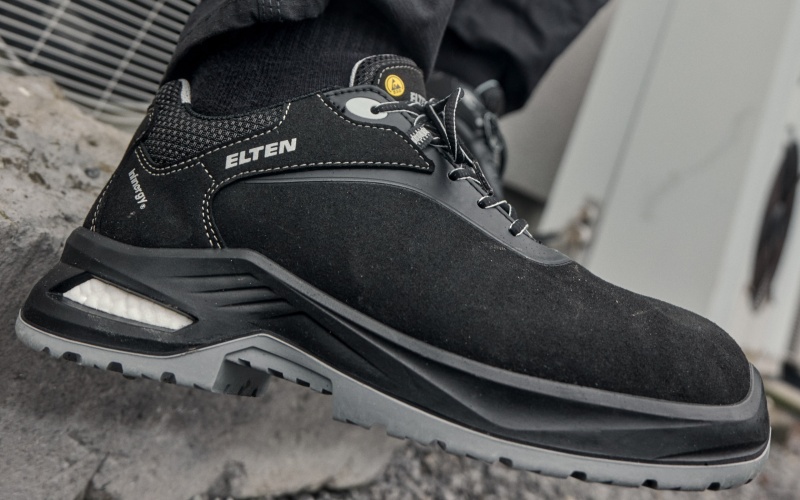
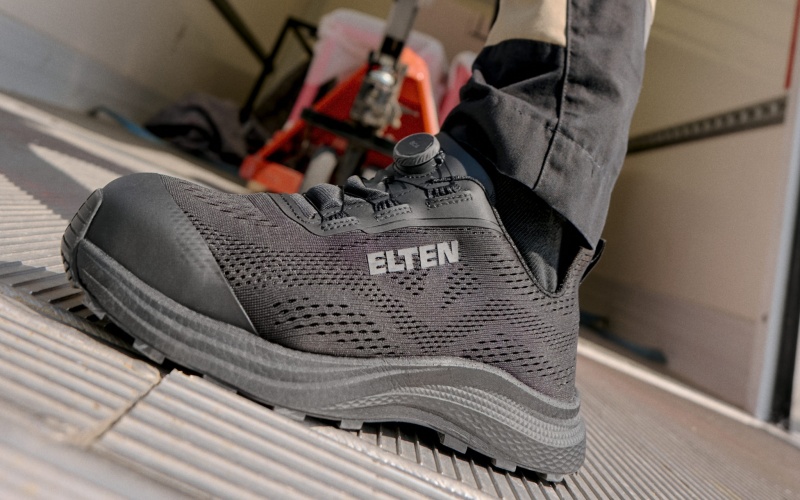
Dr. Katina Ehl: Our goal was to develop a safety shoe that is consistently designed for lightness without compromising on safety or comfort. To achieve this, we examined every single component and reduced weight wherever it made sense and was technically feasible. The result is a safety shoe that’s exceptionally lightweight to wear. The midsole, made entirely of Infinergy, plays a key role in this. This resilient particle foam provides a dynamic walking experience and supports the wearer during long workdays.
Tavixx thus stands above all for lightness. With the Wellmaxx Fit series, Elten takes a different approach to enhancing comfort. What is this all about?
Dr. Katina Ehl: With Wellmaxx Fit, the focus is on the fit. Our goal was to better accommodate different foot shapes and combine this with high-performance cushioning. After all, a safety shoe must not only be lightweight but also fit properly.
What exactly is behind the Wellmaxx Fit concept?
Dr. Katina Ehl: The starting point for this dates back about 20 years. Together with Professor Stefan Grau and his team at the University of Tübingen, we investigated just how different feet actually are. Our findings showed that most feet can be classified into three types. These findings formed the basis for our Ergo-Active series. With Wellmaxx Fit, we’re taking this approach further and, for the first time, combining the fit system for wide, standard, and narrow feet with our cushioning concept. This allows significantly more people to find a safety shoe that fits well and offers high levels of comfort at the same time.
Wellmaxx Fit also includes special women’s fits. Why was this step important?
Dr. Katina Ehl: Women’s feet differ not only in size. There are also anatomical characteristics that we must take into account during the design process. That’s why we manufacture sizes 36 through 39 on special women’s lasts. Our goal was not simply to scale down existing models, but to develop fits that meet the specific needs of female wearers.
Wellmaxx Fit combines fit and cushioning. Why do you think these two factors go hand in hand?
Dr. Katina Ehl: Because comfort always results from a combination of factors. The models in this series also use Infinergy particle foam, which provides a dynamic running experience. While Wellmaxx Feel focuses primarily on lightness, with Wellmaxx Fit we specifically combine the material’s cushioning properties with our fit concept. A good fit ensures that the foot is properly supported in the shoe and has sufficient space. The cushioning material supports movement and helps absorb peak impacts. Only when the fit and material are effectively coordinated can a shoe be created that remains comfortable to wear for many hours.
What role do foot health and ergonomics play in ensuring a safe and productive workday?
Dr. Katina Ehl: Anyone who spends many hours on their feet during the workday quickly notices whether a safety shoe truly fits their foot and suits their job. Pressure points, lack of support, or inadequate cushioning can not only be uncomfortable but also affect movement and concentration. That’s why we don’t view foot health and ergonomics as peripheral issues, but as key factors for well-being, performance, and workplace safety.
Nevertheless, the topic of safety shoes is often reduced to standards and protection classes.
Dr. Katina Ehl: The protective function remains, of course, indispensable. At the same time, users today expect more. A modern safety shoe should protect, be comfortable, and support daily work as effectively as possible. These expectations are not mutually exclusive. On the contrary: The more people enjoy wearing a shoe, the greater its acceptance among employees.
Looking to the future: What developments do you anticipate in safety footwear?
Dr. Katina Ehl: I’m convinced that customization will continue to gain importance. We’re gaining a better and better understanding of how different feet are and how these differences affect comfort. For me, the future lies in concepts that bring protection, fit, cushioning, and individual needs even closer together. At the same time, we know that not every foot can be optimally accommodated with a mass-produced solution. That’s why we’re expanding our offerings with an orthopedic program that includes our own orthopedic shoemaking workshop and orthopedic consultation days at companies. This allows us to provide customized solutions when needed. This combination of standard fit and customized solutions will become even more important in the future.





most read
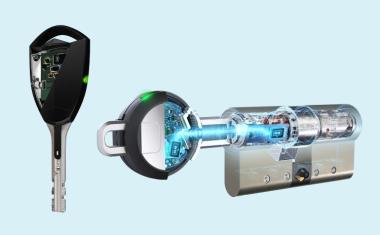
Digital Access with the Familiarity of a Key: A Versatile Combination
As organizations upscale, downsize, or onboard new locations, facility managers must more flexibly manage access control ever and frequently adapt to new situations.
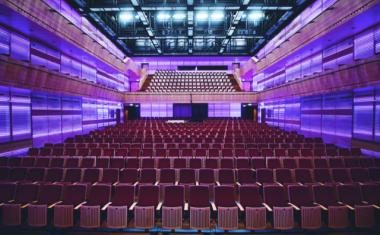
How Dom Eniq Transformed Access Control at Amsterdam’s Muziekgebouw Concert Hall
Muziekgebouw Amsterdam upgraded to the DOM Eniq electronic locking system, giving staff full control over access rights

Perimeter Security in a Practical Test: How the Wehrhan-TPS urban test site makes real attack scenarios visible
NEW SERIES: TEST SITE UNDER TEST. Perimeter security with radar and video management on the Wehrhan-TPS urban test site

Secsolutionforum 2026 to explore integrated security, resilience and regulatory developments in Italy
Secsolutionforum 2026, the event dedicated to physical and digital security, will take place on 7 and 8 October at BolognaFiere, as part of Urban Tech 2026 – The Urban Technology Show.
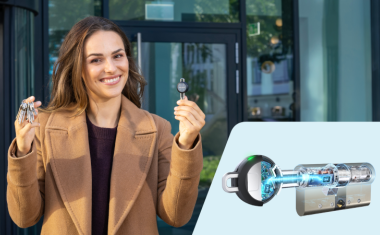
Programmable keys and digital locking cylinders can simplify access and compliance
The key to meeting building managers’ growing security and compliance challenges – without increasing workload or costs – is the implementation of smarter access