
AI Video Analysis in Perimeter Security: Test Results on False Alarms and Environmental Factors – PART 3
SERIES – PART 3. By Hans-Peter Büttner and Ronald Güldner | Video sensing, intelligent analysis, and AI shape modern perimeter security systems. This three-part series explains the fundamentals, analysis methods, and test results. Part 3 highlights test results, environmental influences, and system integration.
All episodes in the series

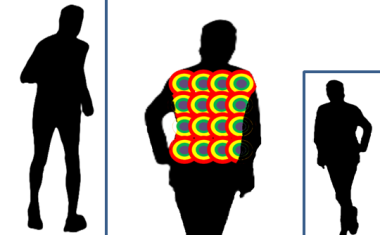
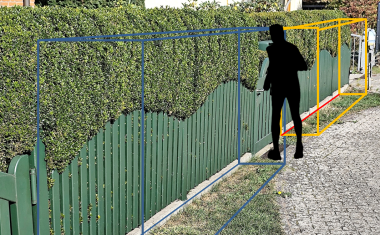
For the tests, new sensor and analysis systems were operated in parallel with an existing video surveillance system that had been in reliable use for quite some time. The test environment mirrored the real-world conditions of perimeter security, including fencing, access areas, and adjacent public spaces.
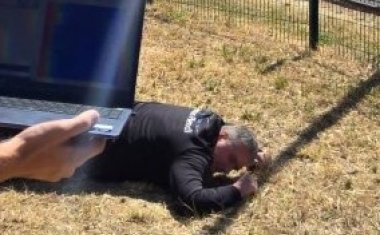
The goal was not only to test the systems under ideal conditions but also to deliberately expose them to complex and stochastic influences. These included both controlled attempts to breach the perimeter and natural environmental factors such as wind, rain, changing lighting conditions, and animal activity.
The results showed that all systems reliably reported security-related attacks. However, differences emerged in the number of unwanted event reports. These false alarms are particularly critical in perimeter security, as they place a burden on security personnel, reduce their alertness, and can lead to delayed responses in an emergency.
The analysis of the test results highlights how strongly the systems’ performance is influenced by external conditions and the role that modern AI methods play in this context.
content:
- Shadow Play: A Complex Influencing Factor
- Heavy Rain and IR Lighting: The Challenge of Nighttime Operations
- Movement of People Along the Perimeter: Shadows, Fence Posts, and Pictorial Perspective
- Bird Activity: An Underestimated Contributing Factor
- Integration with Other Security Components
- Conclusion
- Contact the Authors
Shadow Play: A Complex Influencing Factor
Shadow effects are among the most common causes of false alarms in outdoor areas. Depending on the sun’s position, cloud cover, and wind, constantly changing patterns form on fences, walls, and ground surfaces. Conventional video sensors react to these partial changes in grayscale, as they fundamentally interpret any relevant change in the image as a potential event.
Tests showed that even carefully configured sensor arrays could be triggered by shadows cast by people, vehicles, or vegetation. Particularly critical were situations in which shadows changed rapidly—for example, due to passing vehicles or wind movements in tree canopies. The systems reported these changes as location-based events, even though no security-relevant movement had occurred.
AI-based analysis methods reduced the false alarm rate in these scenarios by more than 80%. The reason lies in the object-oriented evaluation: The AI recognizes that a shadow is not a physical object and does not classify it as a security-relevant movement. As a result, the system remains stable even under rapidly changing lighting conditions. Tests showed that AI systems generated virtually no false alarms, even under extreme shadow patterns.
Heavy Rain and IR Lighting: The Challenge of Nighttime Operations
Raindrops cause global changes in the image that conventional video sensors typically ignore. At night, however, when the scene is illuminated by infrared light, raindrops reflect the IR light to varying degrees. This results in local changes in the image that conventional sensors can interpret as relevant events.
In testing, heavy rain at night led to a large number of false alarms. The raindrops reflected the IR light at different angles, causing the sensor fields to be activated sporadically. These effects are random and cannot be parameterized, as they depend on droplet size, direction of fall, and illumination angle. Even very finely tuned parameterization could not reliably suppress these events.
AI-based analysis methods demonstrated significantly greater robustness in these scenarios. The systems reported only actual movements of people or vehicles. This is a major advantage, as heavy rain occurs frequently in many regions and can severely impair outdoor surveillance.
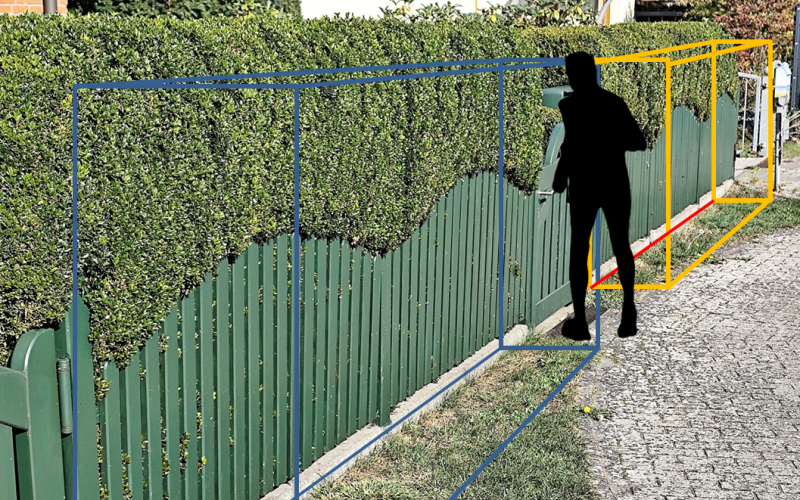
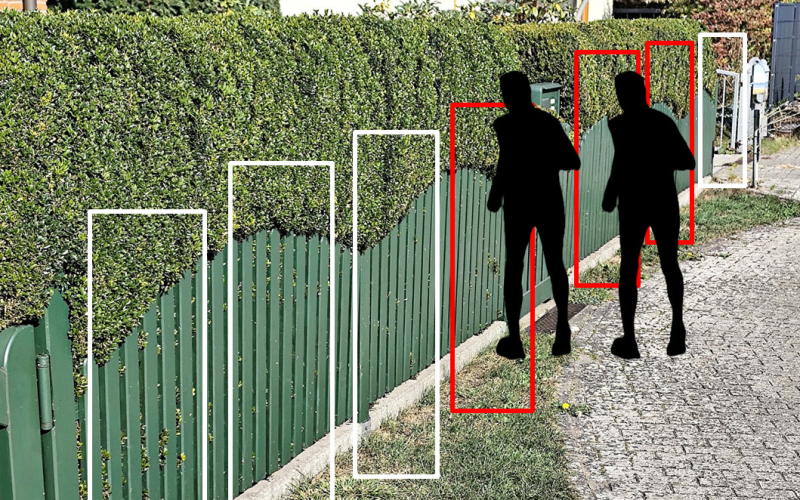
Movement of People Along the Perimeter: Shadows, Fence Posts, and Pictorial Perspective
Bird Activity: An Underestimated Contributing Factor
Birds are among the most common triggers of false alarms in outdoor areas. They land on fences, fly through the scene, or move along the top of the fence. Traditional video sensors interpret these movements as relevant events because they exceed the detection threshold.
The test revealed that bird activity led to numerous false alarms, particularly in the early morning hours and late afternoon. The sensor arrays reacted to the birds’ movements, even though these were not significant from a security perspective. Scenes in which birds landed directly on the top of the fence were particularly problematic, as the sensor arrays were set to be especially sensitive in those areas.
AI-based analysis methods reliably identified birds as such and ignored them. An event was triggered only when an object exhibited the characteristics of a person or a vehicle. This significantly reduced the false alarm rate and improved the stability of the surveillance.
Integration with Other Security Components
Video technology renders three-dimensional scenes in two dimensions. This creates limitations, such as when monitoring gates or historic buildings that cannot be directly equipped with cameras. Public areas located between the camera and the object cannot be reliably blocked out. As a result, movements in the foreground can interfere with surveillance in the background.
Tests showed that combining video sensors with complementary security systems—such as perimeter security systems or laser-based systems using LiDAR technology—significantly improves the robustness of surveillance. LiDAR systems enable true 3D surveillance with centimeter-level accuracy.
The systems are linked via defined event logic. An alarm is triggered only when multiple systems report an event within a specified time frame. This further reduces false alarms and increases the reliability of surveillance.
Conclusion
The test results clearly show that traditional video sensors are prone to false alarms under stochastic environmental conditions. Shadows, heavy rain, bird activity, and people moving outside the scene can lead to numerous unwanted alerts.
AI-based analysis methods offer significantly greater robustness in this regard and substantially reduce the false alarm rate.
Particularly when monitoring areas that require an immediate response from the sensor, a combination of traditional video sensor technology and AI analysis provides a solution that enables both fast and reliable evaluations.
Contact the Authors
Business Partner
B.I.N.S.S. Datennetze und Gefahrenmeldesysteme Berlin GmbHSaaler Bogen 2
13088 Berlin
Germany






most read

Generation change at Elten: Hendrik van Elten on growth, the brand and new requirements for safety shoes
Elten in transition: Hendrik van Elten on international growth and modern safety shoes

Secsolutionforum 2026 to explore integrated security, resilience and regulatory developments in Italy
Secsolutionforum 2026, the event dedicated to physical and digital security, will take place on 7 and 8 October at BolognaFiere, as part of Urban Tech 2026 – The Urban Technology Show.

Certification you can specify with confidence, wherever you're building
Specifying fire detection across Europe is rarely as simple as choosing a product that works.

CSO Interview: Dr. Alexandra Forster on Global Threats, NIS2, and Crisis Management at Bayer
Dr. Alexandra Forster (Bayer) discusses security strategies, threats, and NIS2. Insights into Global Security & Crisis Management

Perimeter Security in a Practical Test: How the Wehrhan-TPS urban test site makes real attack scenarios visible
NEW SERIES: TEST SITE UNDER TEST. Perimeter security with radar and video management on the Wehrhan-TPS urban test site